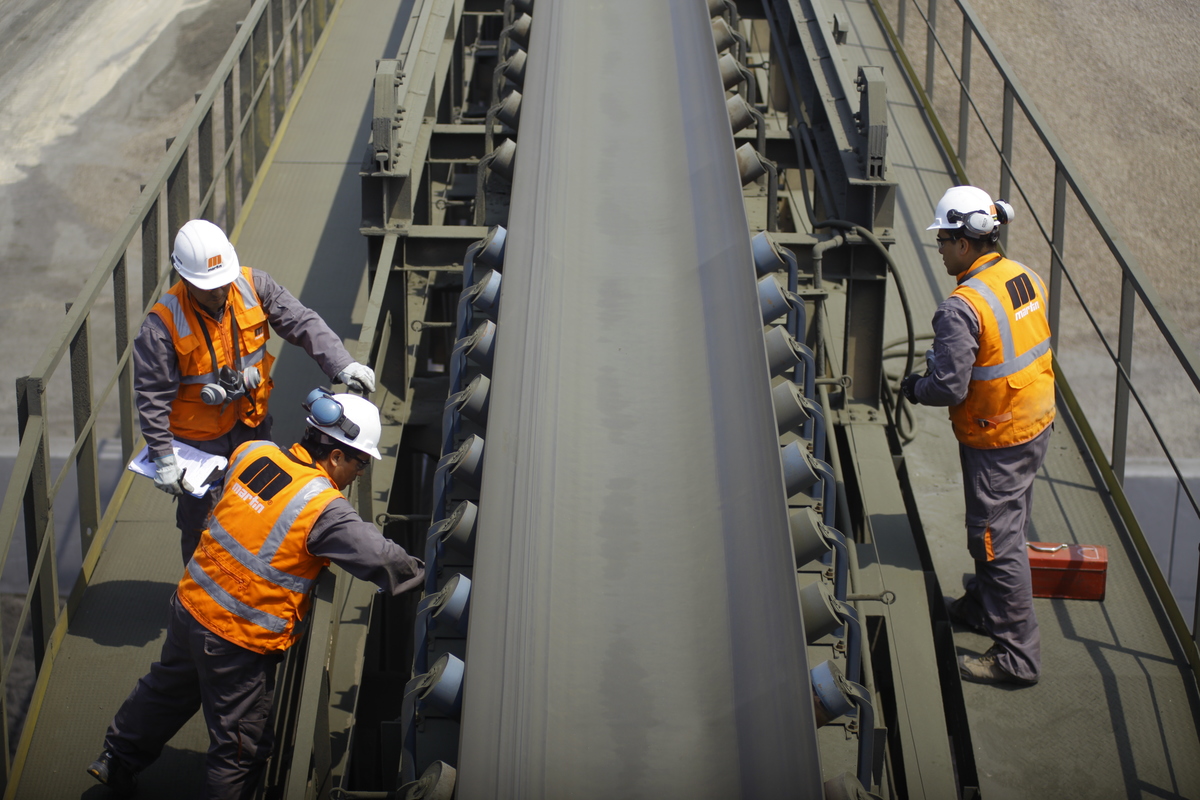
Conveyor belt splicing is where the rubber meets the road — literally — and after maintaining over 200 kilometers of belt across quarries, cement plants, and port terminals, I can tell you that splice quality is the single greatest determinant of belt availability. There are two primary splice methods, and choosing between them is a trade-off between strength and speed. Hot vulcanized splices, when properly executed per DIN 22102 or the belt manufacturer's procedure, achieve 90 to 100 percent of the original belt's rated tensile strength and can last the full life of the belt. However, they require a vulcanizing press, trained technicians, and 4 to 8 hours of belt downtime depending on belt width and rating. Mechanical fastener splices — particularly the Flexco SR (Scamp Riveted) hinged fastener system and the Flexco Bolt Solid Plate series — achieve 65 to 80 percent of belt strength but can be installed in 30 to 90 minutes by a two-person crew with portable tools. For aggregate operations running EP400/3-ply belts at 3.15 m/s, the Flexco SR-3 fastener installed with the Flexco Novitool Aero Splice Press is my go-to recommendation — it delivers consistent joint quality, enables visual inspection of every rivet, and allows field replacement of individual damaged sections without remaking the entire splice.
Belt tracking problems are the second most common cause of conveyor downtime, and they are almost always an installation or loading problem masquerading as an alignment problem. Before installing a single training idler, verify the fundamentals: the conveyor structure must be level and square to within 3 mm per meter, idler frames must be perpendicular to the belt centerline within 1.5 mm across the frame width, and the head and tail pulleys must be parallel with shaft runout under 0.5 mm TIR. Feed chute design deserves equal scrutiny — material should land centered on the belt, in the direction of belt travel, and at a velocity close to belt speed. When I see a belt tracking off at the tail, I check the return idlers for material buildup and the feed point geometry before touching a single idler bracket. Self-aligning training idlers (pivot-type per CEMA Class C5) are useful as a secondary correction, but they cannot overcome structural misalignment or asymmetric loading. Installing them as a primary fix just masks the real problem while the belt edge wears itself to destruction.
Belt cleaning is the third pillar of a complete maintenance program, and it pays for itself in ways that are not immediately obvious. A primary pre-cleaner at the head pulley discharge — such as the Flexco EZP1 with spring-loaded urethane blades — removes 70 to 80 percent of carryback material on the first pass. A secondary cleaner positioned 300 to 600 mm downstream — the Flexco SHD (Super Heavy Duty) with tungsten carbide tips for abrasive materials — captures the fine residue that the primary misses. Together, these two stages reduce carryback to under 50 grams per square meter of belt surface, which translates directly to longer return idler bearing life (less material ingress), reduced belt slip on the drive pulley (cleaner contact surface), and elimination of the material pile-up under return idlers that creates housekeeping hazards and corrodes the conveyor structure. The blade replacement interval is typically 2,000 to 4,000 operating hours depending on material abrasiveness — far cheaper than replacing seized return idlers at $150 each when you have 60 of them on a 300-meter conveyor. We stock the full Flexco cleaner and fastener range in Phnom Penh for next-day delivery, because when a splice fails at 2 AM, the last thing you need is a 6-week international lead time.