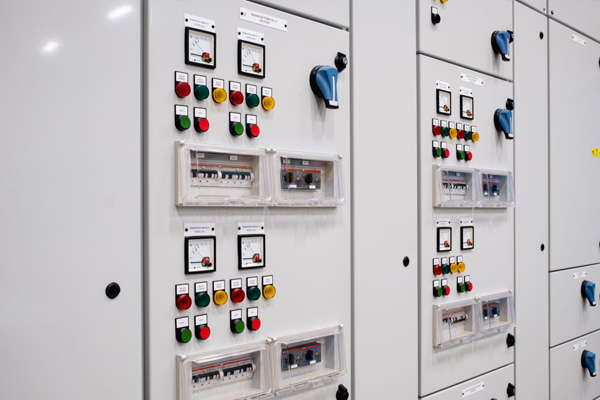
After twenty years of commissioning electrical installations across Southeast Asia, I can say with confidence that 80 percent of panel failures trace back to specification shortcuts made during procurement. Electrical panels and switchgear are not commodity items — they are the central nervous system of your facility, and every decision from busbar material to breaker coordination has downstream consequences. The fundamental choice begins with voltage class. High Tension (HT) switchgear, rated 3.3 kV to 36 kV per IEC 62271, handles utility intake and large motor feeds using vacuum circuit breakers (VCBs) with fault-interruption ratings of 25 kA to 50 kA symmetrical. Low Tension (LT) switchgear, rated up to 690 V per IEC 61439-1/2, distributes power to motor control centers, lighting panels, and auxiliary loads through air circuit breakers (ACBs rated 800 A to 6,300 A) and moulded case circuit breakers (MCCBs rated 16 A to 1,600 A). Getting the boundary between HT and LT wrong — or worse, underrating the prospective fault current at the LT bus — is the kind of mistake that shows up years later as an arc-flash event.
The specification details that separate a 30-year panel from a 10-year panel are not glamorous, but they matter enormously. Busbar sizing must account for continuous thermal rating, short-time withstand (typically 1 second at full fault current), and peak withstand per IEC 61439-1 Table 8. Copper busbars at 1.5 A/mm2 continuous and tinned joints with Belleville washers prevent the hot-spot corrosion that plagues aluminum installations in humid tropical climates. Internal arc classification (IAC per IEC 62271-200) should be specified for any switchgear in an occupied room — this ensures the enclosure directs arc gases through designated flue paths rather than into the operator's face. IP54 ingress protection is the minimum for Southeast Asian factory environments where monsoon humidity regularly pushes ambient conditions to 40 degrees Celsius and 95 percent relative humidity. I have seen too many IP41-rated panels with corroded terminals inside three years of installation.
Modern motor control centers deserve particular attention because they have evolved well beyond simple contactor-and-overload starters. A properly specified MCC today includes withdrawable functional units per IEC 61439-2, allowing live-bus maintenance through shuttered compartments. Each unit should integrate a variable frequency drive or soft starter sized to the motor's full-load current with 110 percent overload for 60 seconds, plus an electronic motor protection relay providing thermal modeling, phase imbalance detection, earth fault, and stall protection. Communication via Modbus TCP or PROFINET to the plant SCADA system enables real-time energy monitoring, predictive maintenance through current signature analysis, and remote start/stop capability. Schneider Electric's Altivar Process 900 series and ABB's ACS880 drives both support these functions natively. When you invest in this level of intelligence at the MCC level, you transform your power distribution from a passive commodity into an active asset management tool — and the payback through reduced energy consumption and avoided unplanned downtime typically arrives within 18 months.