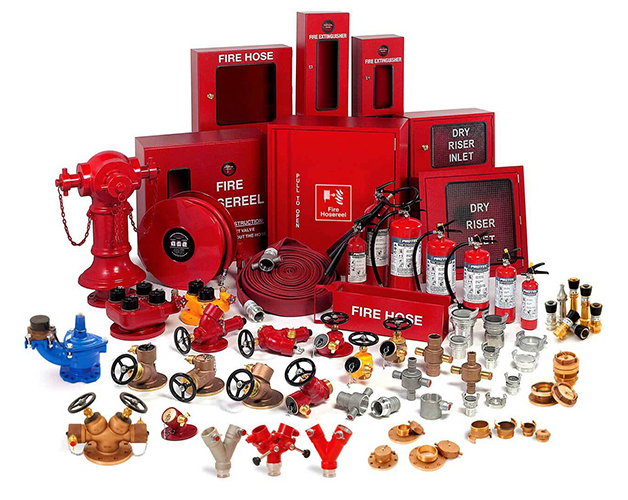
Industrial fire protection is not a single system — it is an architecture of interdependent layers, each designed to compensate for the limitations of the others. In my experience reviewing fire protection designs for manufacturing facilities across Cambodia and Myanmar, the most common and dangerous mistake is treating fire safety as a checkbox exercise: install a few extinguishers, wire up some smoke detectors, and file the certificate. That approach killed 43 workers in the Rana Plaza-adjacent factories and continues to kill workers in facilities where the fire alarm panel has been in fault condition for months because nobody knows how to reset it. Effective industrial fire protection requires three integrated layers: early detection that buys evacuation time, automatic suppression that contains the event, and passive protection (fire-rated walls, cable coatings, dampers) that prevents propagation. Each layer must be designed to NFPA 72 (detection), NFPA 13/15/2001 (suppression), and local building codes simultaneously.
At the detection layer, the choice between conventional and addressable systems is no longer a cost discussion — it is a response-time discussion. Addressable panels like the Notifier NFS2-3030 or Honeywell Morley-IAS communicate with each device individually via SLC loops, identifying the exact detector head in alarm within 10 seconds. For a 50,000-square-meter factory with 400 detection points, this means the difference between searching an entire zone for the source versus walking directly to the affected location. In high-value areas — electrical switchgear rooms, server rooms, chemical storage — aspirating smoke detection (ASD) systems such as the Xtralis VESDA VLP provide sub-0.005 percent per meter obscuration sensitivity, detecting incipient fire conditions 30 to 60 minutes before a conventional spot detector would activate. The investment delta is roughly $15 per square meter for VESDA versus $3 for conventional spot detection, but when the protected asset is a $2 million switchgear lineup or a production-critical server room, the return on that investment is self-evident.
Suppression system selection must be driven by the specific fire hazard, not by contractor preference. Ordinary-hazard manufacturing areas (NFPA 13 OH-1 and OH-2) are well served by wet-pipe sprinkler systems at 6.1 to 8.1 mm/min density over 140 to 230 square meters — these remain the most cost-effective and reliable suppression technology available. Electrical rooms and data centers require clean-agent systems using FK-5-1-12 (Novec 1230, with a GWP of 1 and zero ODP) or HFC-227ea (FM-200), designed to achieve 5.8 to 7.9 percent concentration within 10 seconds of discharge per NFPA 2001. Flammable liquid storage demands foam-water sprinkler or deluge systems per NFPA 15/16, with AFFF or fluorine-free foam (given the ongoing PFAS regulatory transition) at application rates matched to the liquid's fire point and burning rate. Whatever the agent, integration with the fire alarm panel for automatic release — plus manual abort and manual release stations per NFPA 2001 Section 4.3 — ensures both speed and human oversight. Besto Exim supplies complete detection and suppression packages and, critically, provides the commissioning and annual inspection services that keep these systems functional year after year, not just on installation day.